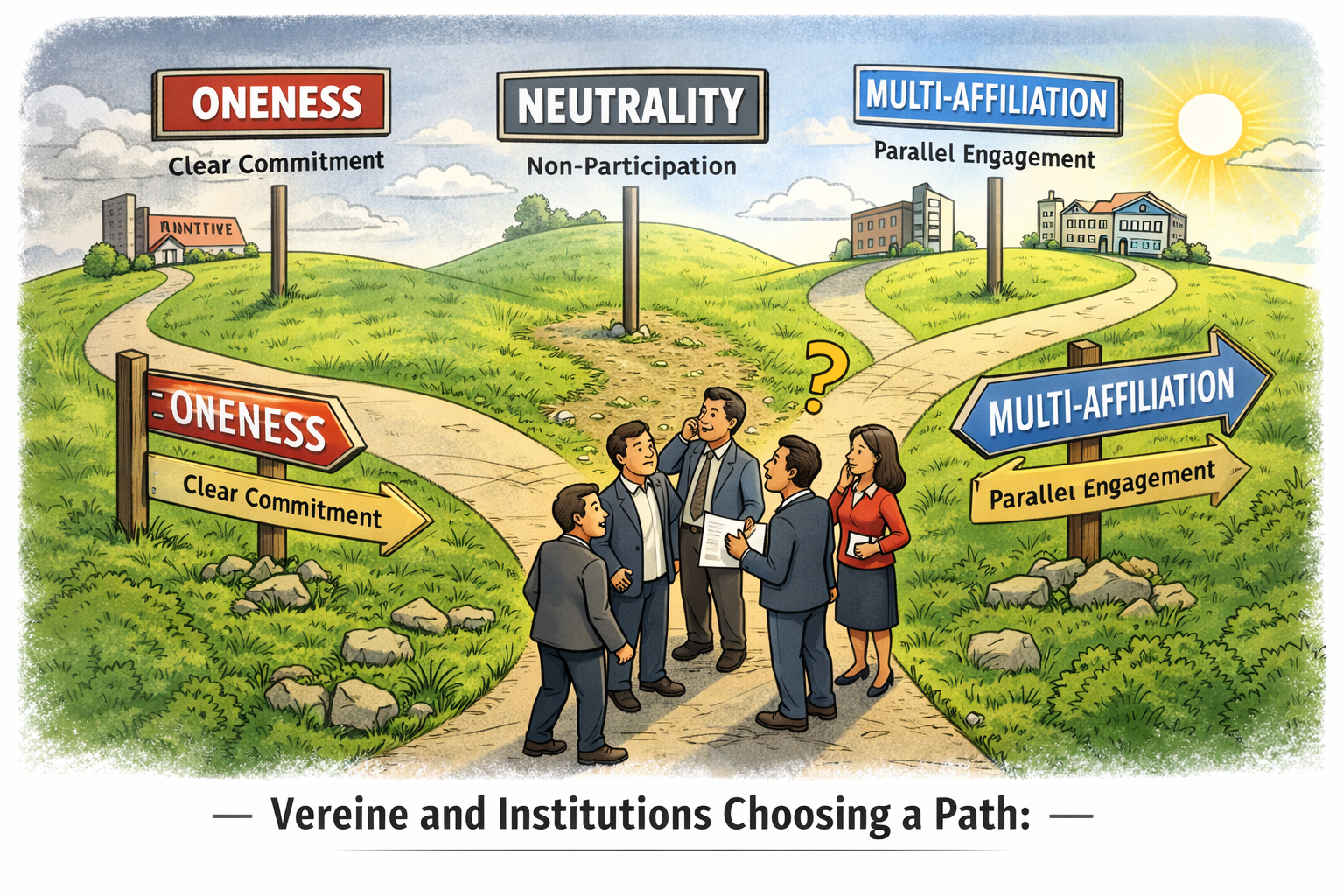
In a landscape where multiple Dachverband initiatives are emerging in parallel, both Vereine and institutions are increasingly faced with a fundamental choice: how to engage in a way that supports clarity, representation, and long-term impact.
This situation is not limited to Vereine alone. It also applies to institutions , partners, sponsors, and broader community stakeholders. Each actor, knowingly or unknowingly, adopts one of three alignment approaches: Oneness, Neutrality, or Multi-Affiliation.
1. Oneness (Single Alignment – 1,0)
Oneness represents clear commitment to a single initiative.
For Vereine, this means aligning fully with one structure and contributing actively to its development. For institutions, it means engaging with one representative body as a primary partner.
The most critical element in choosing Oneness is the clarity of exit criteria defined by initiative.
2. Neutrality (No Alignment – 0,0)
Neutrality reflects a position of non-participation across initiatives.
Stakeholders in this category:
- remain outside both structures
- observe developments from a distance
- delay engagement or commitment
3. Multi-Affiliation (Parallel Engagement – 1,1)
Multi-affiliation refers to engaging with multiple initiatives simultaneously rather than committing to one.
This is a common and natural response in evolving environments. However, multi-affiliation is not a single behavior, but a spectrum that can be grouped into three practical categories:
✅ Bridge-Oriented Engagement
These stakeholders actively try to connect initiatives and strengthen relationships.
- Bridge-Building → connecting initiatives
- Network Building → expanding connections across groups
Bridge-Oriented Engagement is most effective in the early to mid stages (approximately 1–2 months, up to 6 months maximum). Over time, the expectation shifts from connecting initiatives to supporting clear direction. If extended too long, it may be perceived as lack of alignment.
📘 Learning-Oriented Engagement
These stakeholders engage to understand and evaluate before committing.
- Exploratory Engagement → learning before committing
- Strategic Observation → waiting for clarity before aligning
- Risk Mitigation → avoiding early commitment to one side
Learning-Oriented Engagement is typically short-term (approximately 1–2 months, up to 3 months maximum). It enables stakeholders to understand structures and make informed decisions. Prolonged learning without alignment may be seen as indecision.
⚠️ Potential Challenger Engagement
These behaviors may create ambiguity or mixed signals if not managed carefully.
- Information Sharing → passing updates across groups
- Passive Presence → visible, but limited contribution
- Influence Seeking → maintaining relevance across structures
- Resource Optimization → accessing opportunities from multiple channels
- Opportunistic Engagement → shifting positions based on advantage
While bridge-building and learning are valuable in early stages, prolonged engagement without clear alignment may gradually shift stakeholders into the ‘Potential Challenges’ category, as it can lead to ambiguity in representation and slower collective progress
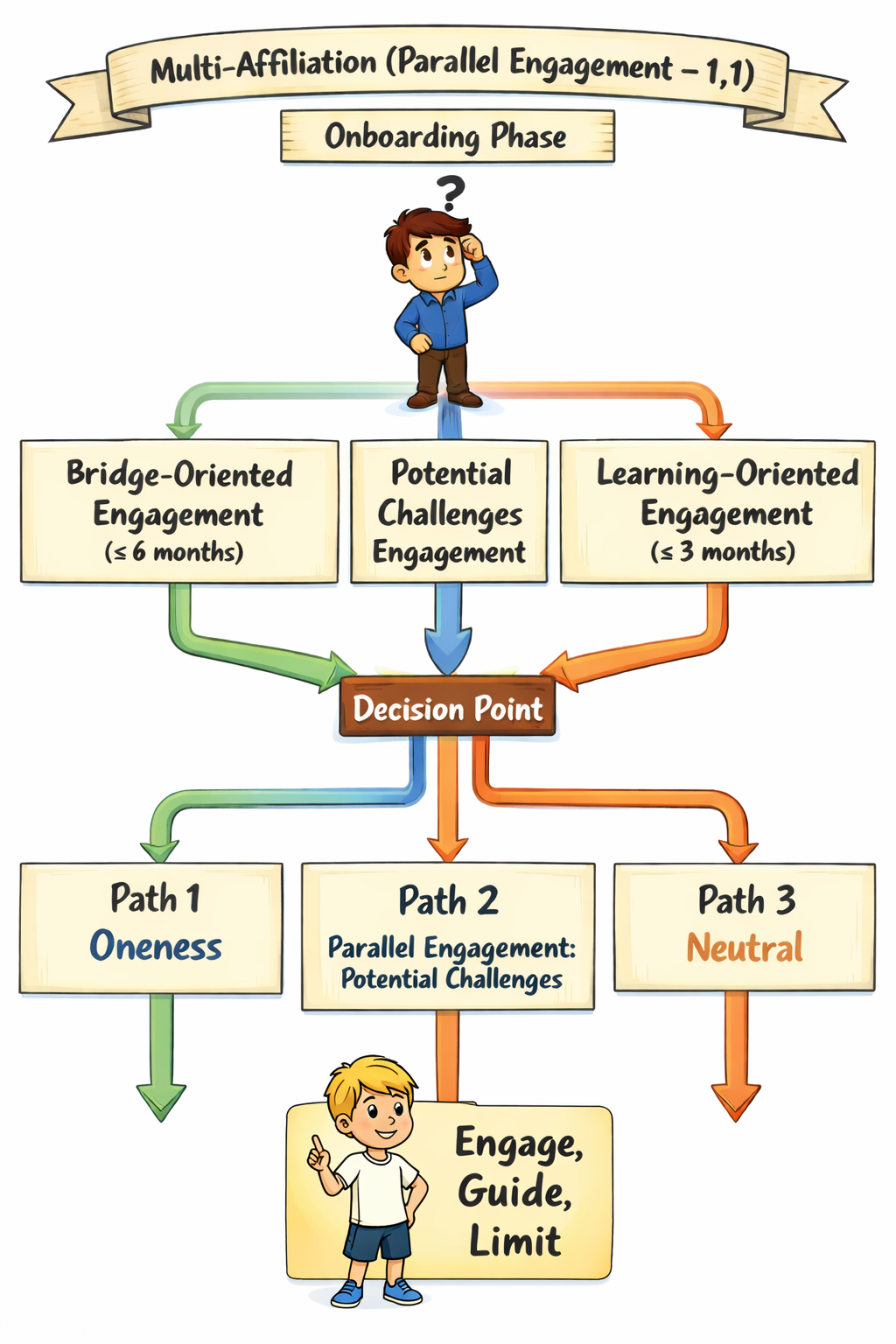
Strategy for Managing Potential Challenges Engagement
Engage. Guide. Limit.
Stakeholders are first engaged and given the space to participate.
They are then guided toward understanding and making a clear alignment decision.If, over time, a decision is not made, it becomes necessary to limit their participation as the structure moves forward.At the same time, it respects both sides by saving time and energy, avoiding prolonged uncertainty. The objective is not exclusion, but structured progression from engagement to alignment.
In dynamic and evolving community ecosystems, multiple forms of engagement are expected. However, as structures mature, the emphasis must shift from participation to clarity, accountability, and representational legitimacy.
the Next Step: Your Contribution Matters
Every Verein has the opportunity to actively shape the future of the Dachverband — including its structure and even its name.
This is where participation transforms into representation.
🔗 Contribute here:
https://form.typeform.com/to/tkZqzChk
🗓️ Deadline: 15 April 2026
A Choice for Clarity and Democracy
In the context of Oneness, Neutrality, and Multi-Affiliation, this step represents something important:
A move toward clear alignment through democratic participation
By contributing:
- you ensure your Verein’s voice is heard
- you support a transparent and inclusive process
- you help build a structure that reflects the collective will of the community
Learn More About the Journey
For those who would like to understand the journey and vision so far: