The Indus Waters Treaty: Legal Analysis with Special Reference to the Dispute Settlement Mechanism .
The Indus Waters System

The Indus river is about 1,800 miles long. Its western tributaries (Kabul, Kurram) are more than 700 miles; the eastern tributaries (Jhelum, Chenab, Ravi, Beas, Sutlej) have an aggregate length of more than 2,800 miles. The system drains 450,000 square miles, and is one of the largest in the world. Most of the basin lies in India and Pakistan, influencing the history, culture and ecosystem of the South Asian region.
Brief Background of Negotiations

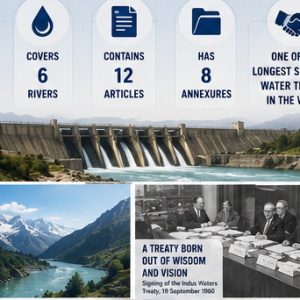
2.The partition of India in August 1947 brought in its wake the Indus waters dispute, eventually requiring negotiations for an agreed solution. The Inter-Dominion Agreement of 4 May 1948 (the Delhi Agreement) was the first regulation of waters between the two countries. While recognizing that a water supply dispute had arisen, the Agreement stated that the ‘proprietary rights’ did not allow West Punjab to claim any share of the East Punjab waters as a right. Pakistan later denounced it on 23 August 1950.
3.In early 1951, David Lilienthal, former chairman of the Tennessee Valley Authority, proposed that India and Pakistan jointly develop the Indus Basin system, using the good offices of the World Bank. Subsequently, World Bank President Eugene Black wrote to the two Prime Ministers on 6 September 1951, proposing this. Both accepted. Black proposed a Working Party of Indian, Pakistani, and World Bank engineers. The negotiations witnessed extreme ups and downs and at times verged on collapse, but the World Bank’s resoluteness kept them buoyant until the Treaty was eventually signed in 1960.
The Treaty and its Legal Structures

4.The Indus Waters Treaty was signed on 19 September 1960 at Karachi, and entered into force on 12 January 1961, with retroactive effect from the ‘Effective Date’, 1 April 1960. It comprises 79 paragraphs under 12 Articles, supplemented by eight annexures. While the Preamble names only the plenipotentiaries of India and Pakistan, W.A.B. Iliff signed on behalf of the World Bank, which is a party only for purposes specified in Articles V and X and Annexures F, G and H.
5.The instrument states that nothing in the Treaty shall be construed as establishing any general principle of law or any precedent, the reference to precedent being designed to forestall arguments based on prescription or servitude. It allocates the Eastern Rivers (Ravi, Beas, Sutlej) to India and the Western Rivers (Indus, Jhelum, Chenab) to Pakistan, subject to specified exceptions.
Objectives
6.The objectives of the Treaty, explicitly laid down in the Preamble reads as follows:

“The Government of India and the Government of Pakistan, being equally desirous of attaining the most complete and satisfactory utilization of the waters of the Indus system of rivers and recognizing the need, therefore, of fixing and delimiting, in a spirit of goodwill and friendship, the rights and obligations of each in relation to the other concerning the use of these waters and of making provision for the settlement, in a cooperative spirit, of all such questions as may hereafter arise in regard to the interpretation or application of the provisions agreed upon herein, have resolved to conclude a Treaty in furtherance of these objectives,”
Dispute Settlement Mechanism

7.Under the heading “Settlement of Differences and Disputes”, the Treaty entrusts the Permanent Indus Commission, comprised of representatives of both countries, with a role in resolving issues, mainly administrative and consultative.
8.Article IX, central to the dispute settlement framework, makes a clearcut distinction between a ‘question’, a ‘difference’ and a ‘dispute’. Any question is first examined by the Commission. If no agreement is reached, a difference is deemed to have arisen, to be dealt with by a Neutral Expert. A dispute is deemed to have arisen only if the difference falls outside Paragraph 2(a) of Article IX, or if the Neutral Expert so informs the Commission.
9.Importantly, the Commission has discretion to decide whether any difference be dealt with by a Neutral Expert or be deemed a dispute, such decision reachable only by agreement within the Commission.
When a dispute has arisen, the Commission reports to the two Governments; either may invite the other to resolve it by agreement, and mediators may be enlisted. A court of arbitration may be established only by agreement, or on the failure of negotiations or mediation to resolve a dispute.
Pre-requisite for the Establishment of a Court of Arbitration

10.The opening language of Annexure G (Court of Arbitration) is critically significant: “If the necessity arises to establish a Court of Arbitration under the provisions of Article IX, the provisions of this Annexure shall apply.” The phrase “If the necessity arises” signifies a stage reached only on fulfillment of certain prerequisites; it is not that any question can be referred to a court of arbitration at the sweet will of either party. A dispute arises only where both Commissioners agree to so deem it, or where the Neutral Expert so informs the Commission, and only thereafter, once negotiation and mediation are exhausted, may the necessity for arbitration arise.
11.A striking difference emerges between handling of a ‘difference’ and a ‘dispute’. While either Commissioner may unilaterally take the initiative for a difference to be dealt with by a Neutral Expert, there is no such provision to unilaterally deem any ‘difference’ a ‘dispute’. It has to be the Commission’s decision in agreement of both Commissioners. Consequently, there arises no question of initiating the Court of Arbitration process unilaterally. A bilateral treaty normally provides for mutual determination, the latter being true with the Indus Waters Treaty.

Effect of the Unilateral Initiation of Process, Violation of the Treaty provision and Options with the other Party
12.If a dispute has not arisen in accordance with the Treaty, a unilateral decision by either party to initiate the process for the creation of a court of arbitration could amount to violation of the Treaty, hence illegal. The other contracting party would obviously look for remedial options.
13.This would raise the question: If one party violates a vital aspect of a treaty, defeating its very purpose, does it not make its continued performance impossible? Many a times the Vienna Convention on the Law of Treaties, 1969 (“the Convention”) is invoked as the most relevant instrument to answer such a question, as many of the Convention’s articles reflect customary international law. Neither India nor Pakistan is a party to the Convention, and the Indus Waters Treaty predates it.
- 14.However,even if the Convention were to be invoked, it must be read together with its key provision of Article 60, which addresses what happens when a treaty is A “material breach” includes violating any provision that is essential to achieving the treaty’s object or purpose. This establishes a clear legal foundation for India.
- Therelevant question then becomes: when Pakistan unilaterally moved to establish a court of arbitration without a dispute having actually arisen as the Treaty requires, bypassing an essential procedural safeguard, does this amount to violating a provision essential to the Treaty’s purpose?
Conclusion
16.The Indus Waters Treaty is a unique bilateral instrument concluded as a consequence of partition of India. The Preamble, Articles and Annexures are equally substantive, and together form the Indus Waters Treaty 1960. The dispute settlement mechanism stipulates that all issues are to be resolved by cooperation in a spirit of goodwill and friendship, avoiding third party involvement to the extent possible. If one party drags the other unilaterally before the Court of Arbitration for the resolution of issues that have not arisen to the stage of a ‘dispute’, it goes against the core intent of the Treaty and may amount to a material breach, making the Treaty’s performance impossible. Given that the spirit and objective of the IWT is premised on ‘goodwill and friendship’, it can be argued that Pakistan’s continuous indulgence in cross-border terrorism could be attributed to its failure to perform the obligations on its part under the Treaty. It, therefore, constitutes a material breach, and India is fully entitled under customary international law to hold the Treaty in abeyance.
*****

Rebuttal to “Sifting IWT Truth from Lies, Myths”(An Indian Perspective – Response to Brig (retd) Dr Raashid Wali Janjua’s letter published in Dawn, April 9, 2026)
Brig (retd) Dr Raashid Wali Janjua’s letter suffers from the very same selective amnesia he accuses India of. An unbiased examination of the facts reveals that several of his contentions are historically incomplete and legally imprecise.
The author invokes the closure of the Central Bari Doab and Depalpur canals in 1948 as evidence of India’s predatory intent. He omits the essential context: these canals drew water from headworks that lay entirely within Indian Territory after Partition, and the supplies were interrupted during an extraordinarily complex process of partition of India. The matter was swiftly resolved through the Inter-Dominion Agreement of May 4, 1948, in which Pakistan itself acknowledged India’s sovereign rights over the headworks and agreed to pay seigniorage charges for continued water use. Far from being an act of malice, this is evidence of India’s intent to resolve every issue amicably.

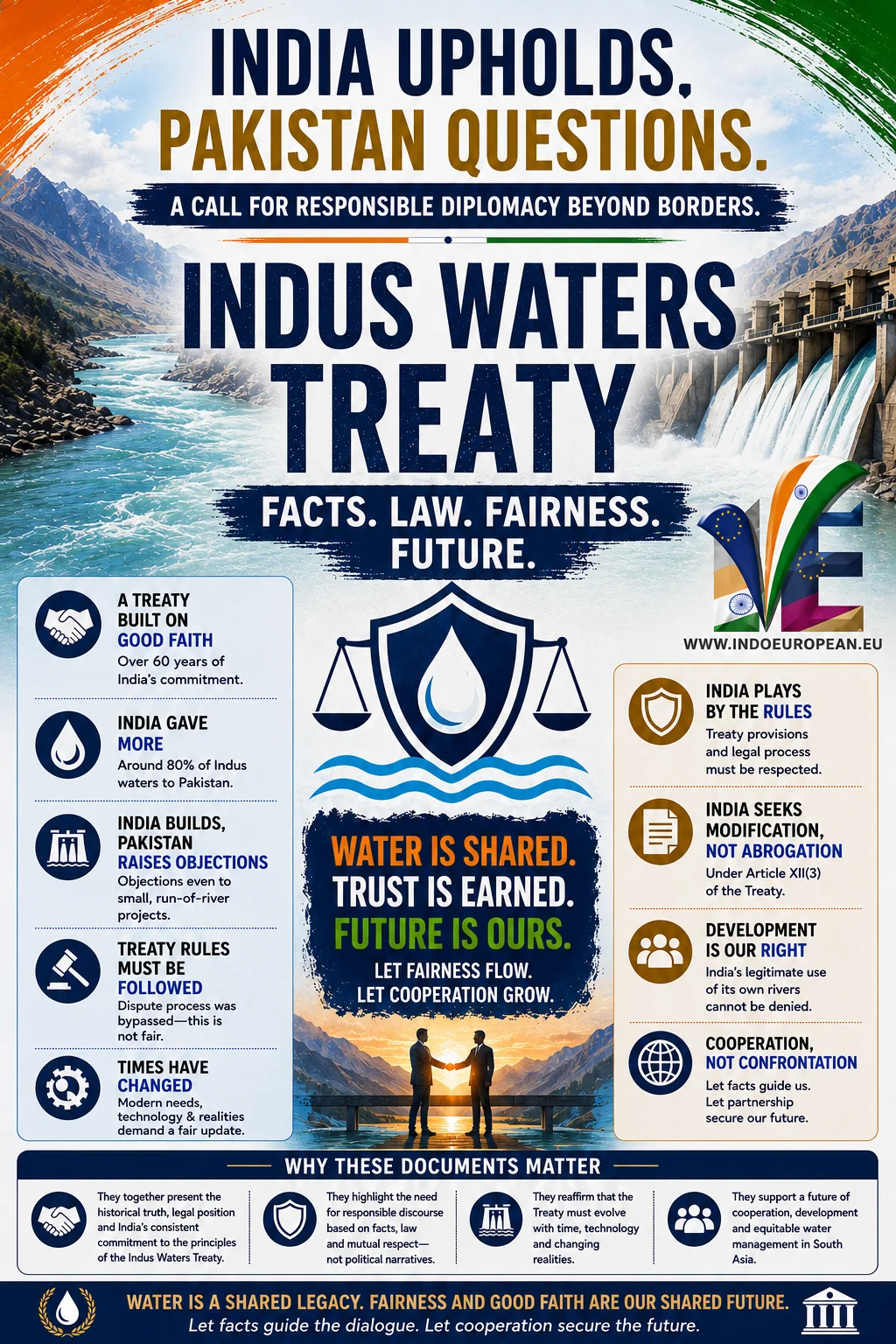
The author asserts that IWT has served Pakistan’s water interests well, yet simultaneously and paradoxically accuses India of “continual attempts at filching” Pakistan’s water. The fact is that the Indus Waters Treaty of 1960, signed after nearly a decade of negotiations, is one of the most generous trans boundary water treaties in the world from the lower riparian’s perspective. India not only relinquished its rights to approximately 80 per cent of the total Indus system waters but also paid an amount of approximately £62 million (approximately ₹227.5 billion in present value) as compensation for replacement works in Pakistan-occupied Kashmir to secure use of waters which were already hers. No comparable concession by an upper riparian exists in modern water treaty history.
Janjua correctly notes that India is permitted cumulative storage of only 3.6 MAF on the Western Rivers, and that run-of-river hydroelectric projects must not alter the downstream flow regime. This is precisely India’s position as well. The dispute fundamentally revolves around Pakistan’s interpretation of “alteration of the downstream flow regime”. Pakistan has been deploying this as an objection against every hydroelectric project India has sought to construct on the Western Rivers, regardless of project size or design. The pattern is revealing. Uri II, a project with zero pondage, was objected to. Lower Kalnai attracted objections despite the difference between India’s designed pondage and Pakistan’s computed figure being a matter of decimal fractions. In both cases, the factual basis for objection was negligible to the point of being technical pretext rather than substantive concern.
Pakistan has further raised objections to the Kishanganga and Ratle hydroelectric projects, both legitimate run-of-river projects fully consistent with the Treaty’s provisions, by asking the World Bank to appoint a Court of Arbitration, thereby bypassing the Neutral Expert mechanism provided under the Treaty. India’s objection to the Court proceedings is not an attempt to escape accountability; it is a principled position that Treaty-mandated dispute resolution mechanisms must be fully exhausted before resorting to arbitration, as expressly required under Article IX of the IWT itself. Pakistan’s unilateral invocation of the Court of Arbitration, bypassing the sequential dispute resolution ladder, is itself a breach of Treaty obligations.
India issued a notice in January 2023 seeking modification of the IWT under Article XII(3), citing Pakistan’s persistent obstruction of Treaty mechanisms and unilateral resort to external arbitration as conduct incompatible with the spirit of the Treaty. This is not a unilateral abrogation but a legally available remedy. The Treaty requires renegotiation to reflect six decades of changed circumstances, including technical advancements, India’s own developmental needs on the Western Rivers, and Pakistan’s bad-faith use of dispute resolution provisions. India is exercising a Treaty right, not violating one.
The Egypt-Ethiopia and Syria-Iraq comparisons actually undercut Janjua’s argument rather than supporting it. In those cases, there are no legally binding bilateral treaties at all, which is precisely why those lower riparians are vulnerable. Pakistan, by contrast, had a detailed, legally binding Treaty with India, which was grossly used as a political tool and not for development.

Responsible commentary on a Treaty of this complexity must rise above the narrative of predators and prey. The Indus Waters Treaty had endured for over six decades because of the generous attitude of India. India’s concerns reflect a legitimate recognition of changed circumstances, and that the Treaty cannot indefinitely be wielded as a political instrument to obstruct India’s lawful utilisation of its own river waters. Such inflammatory rhetoric by Pakistan clearly bring out its intent and justifies India’s stance.

The writer is a former Indian Commissioner for Indus Waters .